
When times are tough, recruitment businesses often look to cut back. But rather than shrinking, there’s a stronger case for sharpening: understanding where money is going, identifying what works, and making smarter decisions across your processes.
From working with hundreds of agencies, we’ve seen that one of the biggest opportunities to boost margins lies in how recruitment businesses use technology. Not adding more tools – but using the right ones better.
Here are three practical ways to improve your margins without sacrificing performance:
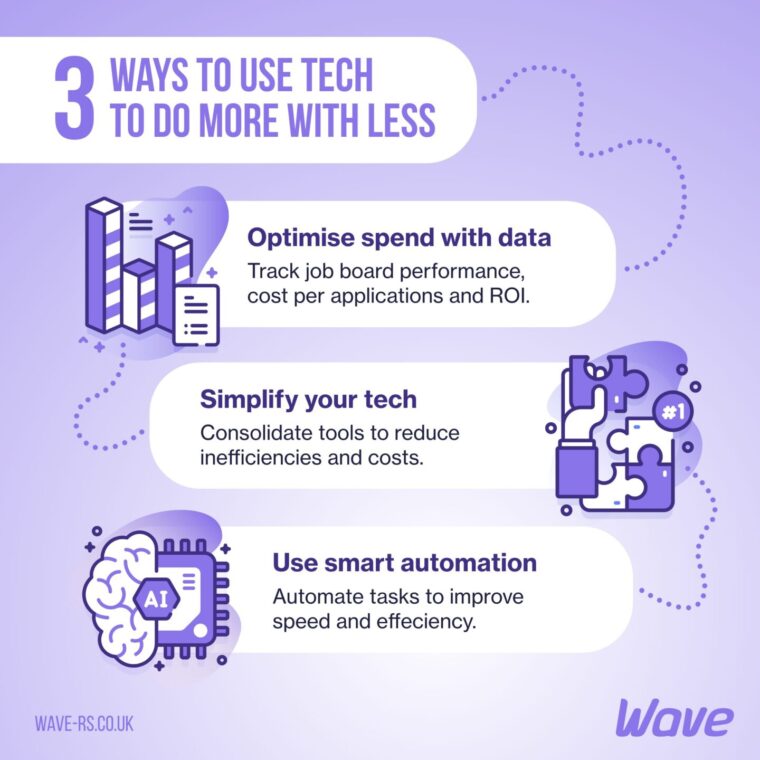
1. Optimise your job board spend with data, not guesswork
Job board costs can be one of the biggest overheads for a recruitment business, and also one of the easiest to waste. It’s common for consultants to rely on habit or preference when posting jobs, which often leads to overspending on platforms that underperform.
Instead, track where your applications (and more importantly, your placements) are really coming from. Look at cost per application and conversion rates by platform, role type and sector. You might find you’re spending the most in places that deliver the least.
Actionable tip: If you don’t already, start capturing the source of every application and measuring it against outcomes. Even a basic report can help you reallocate spend where it matters most. And don’t forget your recruitment website – if it’s optimised properly, it should be one of your most cost-effective channels.
Recommended reading: How data killed ‘spray and pray’ job board advertising
2. Consolidate your tech to reduce overlap and friction
Over time, recruitment agencies can accumulate a stack of different tools: one for posting jobs, one for sourcing, another for your CRM, another for your website, another for analytics… and so on.
Each tool might serve a purpose, but juggling multiple systems often creates inefficiencies, both in terms of cost and time. There are also hidden costs associated with context-switching, duplicated work, and poor data visibility.
Taking stock of your current setup and identifying where tools can be combined or simplified can lead to immediate savings and a smoother process for your team.
Actionable tip: Map out your current workflow and the tools you use. Where are the overlaps? Are you paying for features in one system that another already covers? Your tech might already offer built-in functionality for tasks such as posting jobs, tracking performance, parsing candidate data, or even managing and shortlisting applications. It’s worth reviewing what your existing setup can already handle before adding more to the stack.
3. Use automation to speed up, not cut corners
Automation doesn’t have to mean removing the human element. When used effectively, it streamlines the tedious tasks (such as posting, matching, shortlisting, or sending updates), allowing your consultants to spend more time with clients and candidates.
It’s not about replacing recruiters – it’s about helping them focus on the parts of the job that make the most impact.
Actionable tip: Identify the tasks that slow down your team. Posting jobs across multiple platforms, tracking and reviewing applications can be time-consuming. The right tech can simplify all of this. Tools that integrate with your website and job boards, surface relevant candidates, and reduce manual admin help, free up time for work that adds more value.
Improving margins doesn’t always mean cutting. It often means improving. By making better decisions with your spend, simplifying your tech stack, and letting automation handle repetitive tasks, you give your team more time to focus on what truly drives growth.