
- Do publish the salary
- Don’t publish a huge salary range
- Do publish the location, even for a remote role
- Don’t list the job as remote if in reality it’s not
- Do include the benefits, plus essential skills and responsibilities
- Don’t write the entire job description
- Do use a personable tone
- Don’t use quirky job titles in an attempt to grab attention
- Do keep the length to 300-350 words
- Don’t use more than 5 bullet points in a list
- Do ensure the language you use is non-discriminatory
- Don’t use industry jargon
- Do Include keywords in the title, description and company description
- Don’t overstuff your copy with keywords
Most successful hires start with a great job advert. Unless you’ve directly sourced a candidate from your CRM or via a referral, a job advert marks the start of your candidate attraction journey. Without an optimised job ad you’ll struggle to find quality candidates at pace and you’ll be at a disadvantage at every stage onwards.
However, crafting an advert that is picked up in searches by relevant candidates, engages them instantly, compels them to read to the end and encourages them to apply is no mean feat. Recruiters aren’t copywriters but nor do they need to be with the right guidance on optimisation. Just as important is the realisation that, as a recruiter, you know how to sell a job to a candidate – you do that every day. It’s translating that knowledge into words on a screen that many find tricky. There’s tech that can help with that – AI can now help turn your job info and benefits into a fully fledged, well structured job ad. All it needs is the right prompts and an edit with the human touch.
But even without the help of AI, as long as you follow basic guidelines and impart the right information in a readable way that generates interest and excitement for the job, you’re doing all the right things. And that last part you do all the time on the phone or in person when you speak to candidates so take that and write it down.
What’s essential is that the basics are there, which is what has prompted me to write the ultimate list of dos and don’ts when it comes to writing job adverts. Follow these and you’ll be off to a great start!
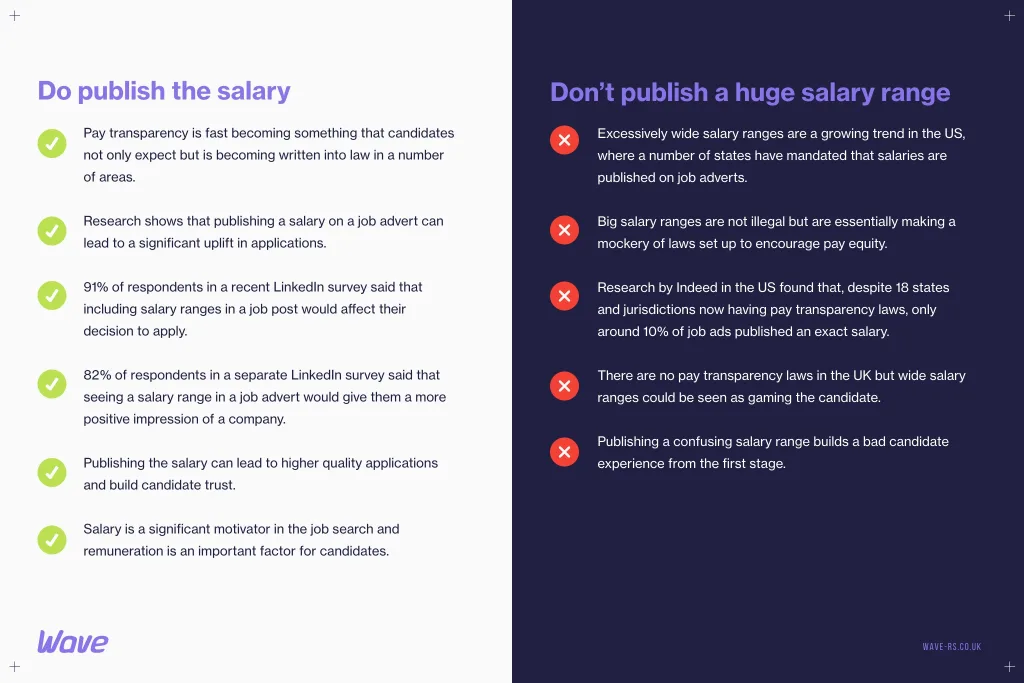
Do publish the salary
Whether or not to post the salary on a job ad has been a contentious issue for years amongst recruiters but pay transparency is fast becoming something that candidates not only expect but is becoming written into law in certain areas. Some argue that disclosing a salary can give competitors insight into an organisation’s rates of pay and reduce their ability to negotiate. However, numerous research has revealed that publishing a salary on a job advert can lead to a significant uplift in the number of applications received. Research aside, it just makes sense – would you apply for a job with no idea of the salary being offered? Remuneration is a huge part of why we work – and even more so at a time of high cost of living so it’s no wonder it’s a significant motivator in the job search.
In a recent survey conducted by LinkedIn, 91% of respondents said that including salary ranges in a job post would affect their decision to apply and, in a separate LinkedIn survey, 82% of respondents said that seeing a salary range in a job description would give them a more positive impression of a company. Publish the salary and you’ll not only receive a higher number of applications, they’ll also be of a higher quality – you won’t get halfway through the interview process only for them to drop out because they realise the salary doesn’t meet their expectations. You’ll also gain candidate trust, fostering an honest and transparent relationship which helps to create a positive candidate relationship from the very start of the process. I’ve written an entire article just on the importance of salary transparency in job adverts so do check it out here if you want to read more about it.
Don’t publish a huge salary range
A salary range that’s tens of thousands of pounds wide does not amount to salary transparency. It seems to be a growing trend in the US, where a number of states have mandated that salaries are published on job adverts. Technically and legally they’re covered but it’s making a mockery of the pay transparency laws. Essentially, they’re gaming laws set up to encourage pay equity. Research by Indeed in the US found that, despite 18 states and jurisdictions now having pay transparency laws, only around 10% of job ads published an exact salary.
Here in the UK there are no such laws around pay transparency but the number of job adverts that include a salary is growing. What is crucial is that the salary that is published gives candidates a realistic idea of what they might be offered. I’ve seen salary ranges spanning a £50,000 difference. That, to me, feels like gaming – not gaming the law as there isn’t one but gaming the candidate, which certainly wouldn’t make me want to apply. It’s crucial that the candidate experience is positive from the very beginning and publishing a confusing salary range isn’t a great start.
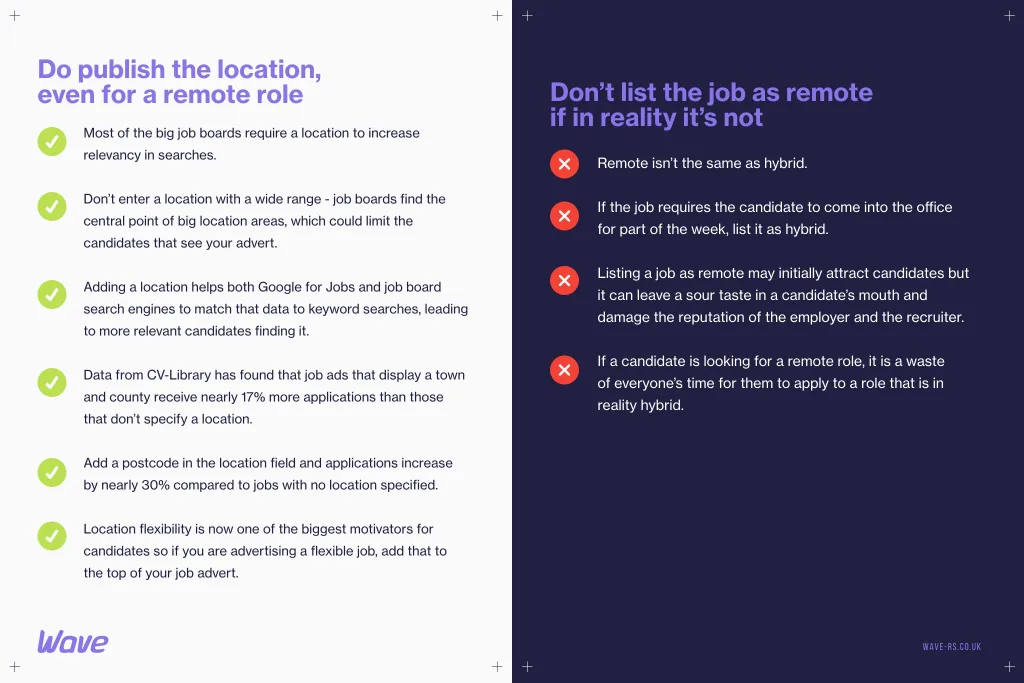
Do publish the location, even for a remote role
Most of the big job boards require you to list a location to increase relevancy in searches but don’t use a location with a wide range thinking that it will be shown to all relevant candidates in that area. If you add a vague location such as ‘South East England’ the job board will simply find the central point in that area and code it as such, which could hugely limit the candidates that see your advert. Adding this kind of structured data makes it easier for both Google for Jobs and job board search engines to pick it up from keyword searches and will help candidates to immediately see whether a job is suitable for them. Data from CV-Library has found that job ads that display a town and county receive nearly 17% more applications than those that don’t specify a location. Add a postcode and that percentage rises to just under 30%.
If you are advertising a remote/work from home/work from anywhere/hybrid position, just add that to the top of your job advert. Alongside salary, location flexibility is now one of the biggest motivators for candidates so making it obvious if that is an option will likely further increase applications.
Don’t list the job as remote if in reality it’s not
I have seen so many posts on LinkedIn from disgruntled candidates that have applied for a job on the basis that it’s remote only to find out, sometimes several interviews in, that the employer actually wants them to come in 2 or 3 days a week. Remote isn’t the same as hybrid – if the job is actually hybrid, list it as such. Listing a job as remote may initially attract candidates but, ultimately, not only is it a waste of everyone’s time, it will leave a sour taste in a candidate’s mouth and could damage both the reputation of the employer and the recruiter.
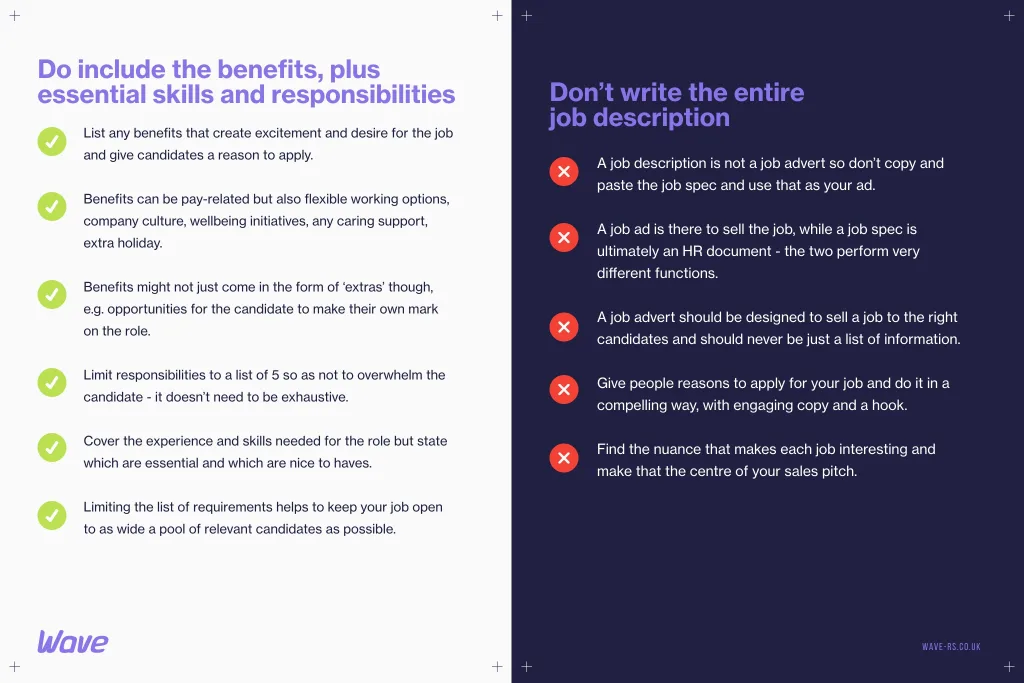
Do include the benefits, plus essential skills and responsibilities
There are 2 parts to this – give candidates a reason to apply and keep it open to as wide a pool of relevant candidates as possible. Firstly, benefits. Always have in the back of your mind, “why would I apply for this job if I were a candidate in this field?” List any benefits that create excitement and desire for the job. Pay-related benefits are great but there are several other candidate drivers. Flexible and/or remote working is now one of the biggest candidate wants (bordering on an expectation in some industries) so be sure to prominently mention that if the role offers it. Emphasise company culture, wellbeing initiatives, any caring support, extra holiday – anything that will further sway a candidate and encourage them to apply. Benefits might not just come in the form of ‘extras’ though. There may be opportunities to make your own mark on the role, such as creating your own strategies or forming a team of your own.
You’ll also need to succinctly explain how the role fits into the business, what the candidate will be doing on a daily basis, and list the key responsibilities of that role. However, don’t overwhelm the candidate – stick to 5 main responsibilities. Take a similar stance with skills. Cover the experience and skills needed for the role but state which are essential and which are nice to haves. As with responsibilities, don’t lay down a long list of required skills and experience as that can deter many, especially diverse candidates. If you do ask for a specific skill and/or qualification, always state the reason that skill will be needed.
Don’t write the entire job description
A job description is not a job advert. Please don’t copy and paste the job spec and use that as your ad. A job ad is there to sell, a job spec is ultimately an HR document – the two perform very different functions. The job description will detail everything that a role requires and everything that a candidate needs in order to perform the job successfully. It will be an exhaustive list of responsibilities, activities, duties, qualifications and skills. It’s a dry, factual document that needs to be written but is not a job advert.
Aside from the SEO side to job ads that makes sure they are found by the right candidates, the most important thing to remember about a job advert is that second word – advert. Always remember that you are selling a job. This is where you need be a marketer. Just as a consumer advert is designed to sell a product or a service to someone, a job advert should be designed to sell that job to candidates. It cannot be merely a list of information – as above, that’s the job description and not a job advert. Give people reasons to apply for your job and do it in a compelling way. Ensure your copy engages the reader and reels them in. Keep them hooked by writing copy that isn’t dry and that makes them want to apply for the job. Find the nuance that makes this job interesting. Even jobs that on paper might not seem exciting will have something that makes them different or that could be the hook – work out what that is and make that the centre of your sales pitch.
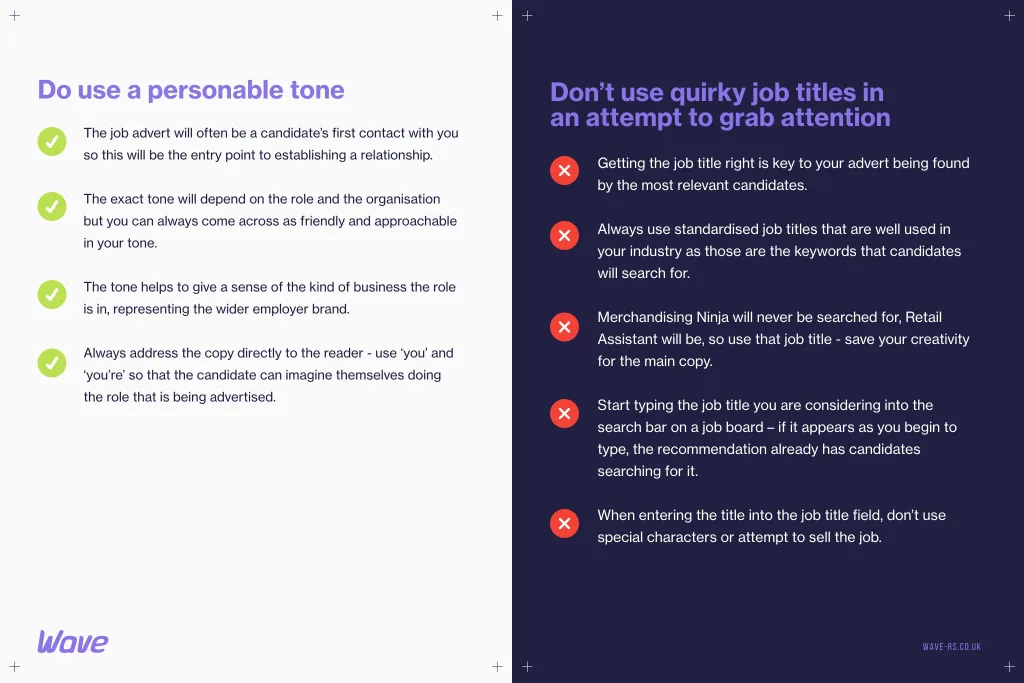
Do use a personable tone
The job advert will often be a candidate’s first contact with you so this will be the entry point to establishing a relationship. The exact tone will depend on the role and the organisation – some need a more corporate tone than others – but you can always come across as friendly and approachable in your tone. In fact, the tone helps to give a sense of the kind of business the role is in, representing the wider employer brand. In all circumstances, address the copy directly to the reader – use ‘you’ and ‘you’re’ so that the candidate can imagine themselves at the company doing the role that is being advertised.
Don’t use quirky job titles in an attempt to grab attention
Getting the job title right is absolutely key to your ad even being found by the most relevant candidates. Being creative with the job title may seem like a clever way to attract candidates but this often backfires. Why? It’s all to do with keyword searches. Candidates will use standard, well-used keywords when searching for jobs and if your job title doesn’t contain those keywords it will be difficult for them to find it. For example, if you’re advertising for a Retail Assistant, use that exact job title. Whilst Merchandising Ninja might sound more fun, no-one looking for a Retail Assistant job is going to be searching for those keywords.
Top tip: start typing the job title you are considering into the search bar on a job board – if it appears as you begin to type, don’t try to use something else thinking that you’ll beat the system. This means that the recommendation already has candidates searching for it. Also, when entering it into the job title field, don’t use special characters or attempt to sell the job – that’s not the purpose of the job title.
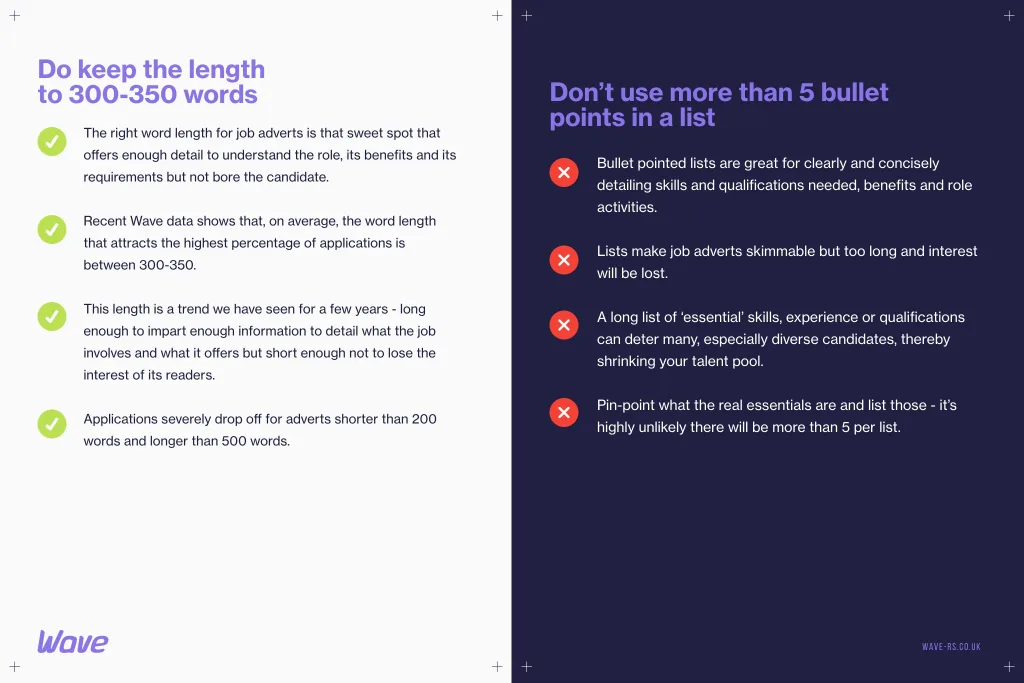
Do keep the length to 300-350 words
Advert length is important. What you’re looking for is that sweet spot that offers enough detail to understand the role, its benefits and its requirements but not bore the candidate before they’ve even finished reading. As mentioned earlier, a job ad shouldn’t be a copy and pasted job description. Its function isn’t to list every detail on the role but to sell the job to relevant candidates.
Recent Wave data shows that, as an average across all industries, the word length that attracts the highest percentage of applications is between 300-350, closely followed by 250-300 and 350-400. This is a trend we have seen for a few years. It seems to be the number that is long enough to impart enough information to detail what the job involves and what it offers but short enough not to lose the interest of its readers. Any shorter than 200 words and applications severely drop off, as with job adverts that are longer than 500 words.
Don’t use more than 5 bullet points in a list
Bullet pointed lists are great for clearly and concisely detailing elements such as skills and qualifications needed, benefits, or role activities. It makes them skimmable for candidates who are trawling through a number of job ads on a time limit. However, make it a long list and people’s eyes will glaze over. Even worse if it’s a long list of ‘essential’ skills, experience or qualifications – that is sure to deter a huge number of potentially great people, especially diverse candidates. Pin-point what the real essentials are, the ‘cannot do do this job without…’ criteria and list those – it’s highly unlikely there will be more than 5 per list. Publish an unreasonably long list of criteria and your talent pool will immediately shrink.
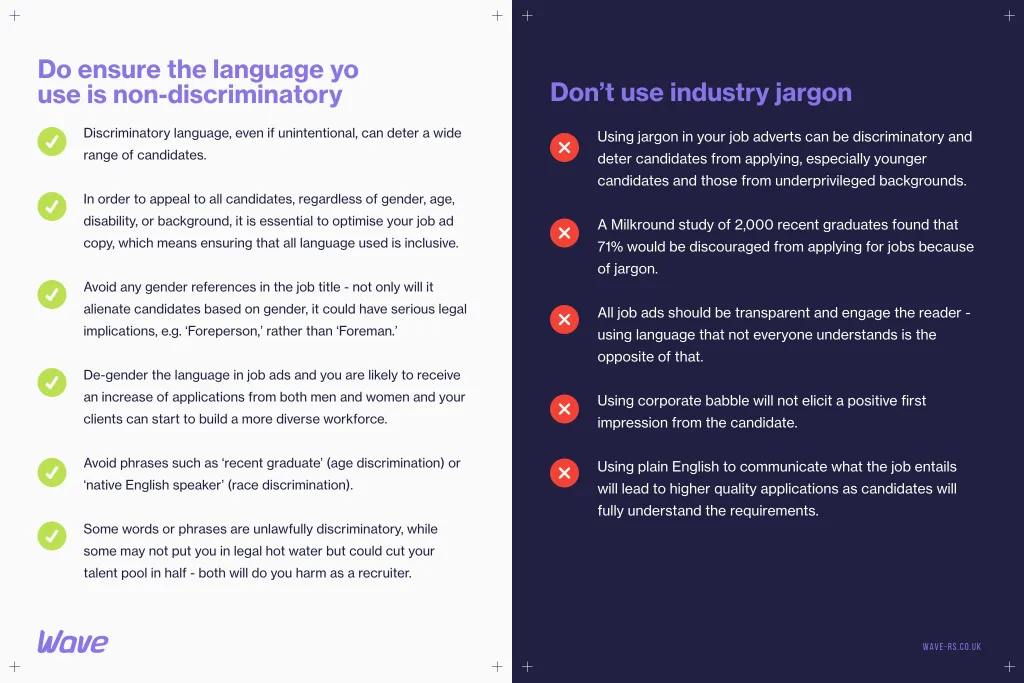
Do ensure the language you use is non-discriminatory
The language you use in your job adverts can deter a range of candidates if you’re not careful. This starts with the job title. Anything with ‘man’ in the title is a big no – not only will it alienate candidates based on gender, it could have serious legal implications. Replace ‘Foreman’ with ‘Foreperson,’ ‘Chairman’ with ‘Chairperson,’ and so on. In order to appeal to all candidates, regardless of gender, age, disability, or background, it is essential to optimise your job ad copy, which means ensuring that all language used is inclusive and this goes far beyond removing ‘man’ or ‘woman’ from your job titles.
There are some fascinating studies on this, some of which are detailed in my article on the importance of gender-neutral wording in job ads which you can read here. Essentially, when you de-gender the language in your job ads, you are likely to receive an increase of applications from both men and women and your clients can start to build a more diverse workforce. Words are powerful and attention needs to be paid to ensure you’re not unintentionally discriminating in any way. This includes avoiding phrases such as ‘recent graduate’ or ‘native English speaker.’ Some words or phrases are unlawfully discriminatory, while some may not put you in legal hot water but could cut your talent pool in half. Both will do you harm as a recruiter so taking time to ensure the language you use in your job ads isn’t discriminatory pays off a hundred fold.
Don’t use industry jargon
Using jargon in your job adverts can also be discriminatory and deter candidates from applying, especially younger candidates and those from underprivileged backgrounds. A Milkround study of 2,000 recent graduates found that 71% would be discouraged from applying for jobs because of jargon. All job ads should be transparent and engaging and using language that not everyone understands is the opposite of that. Use plain English to communicate what the job entails and not only will you likely see an increase in applications, the quality will be higher as candidates will fully understand the requirements and won’t feel intimidated.
There is no real benefit to using jargon in job adverts. It can confuse, intimidate and be incredibly off-putting – none of the things you want candidates to experience. As the first point of communication you and the employer are likely to have with candidates, this does not set a good tone. Always substitute corporate babble with meaningful and clear language that sells the job to candidates.
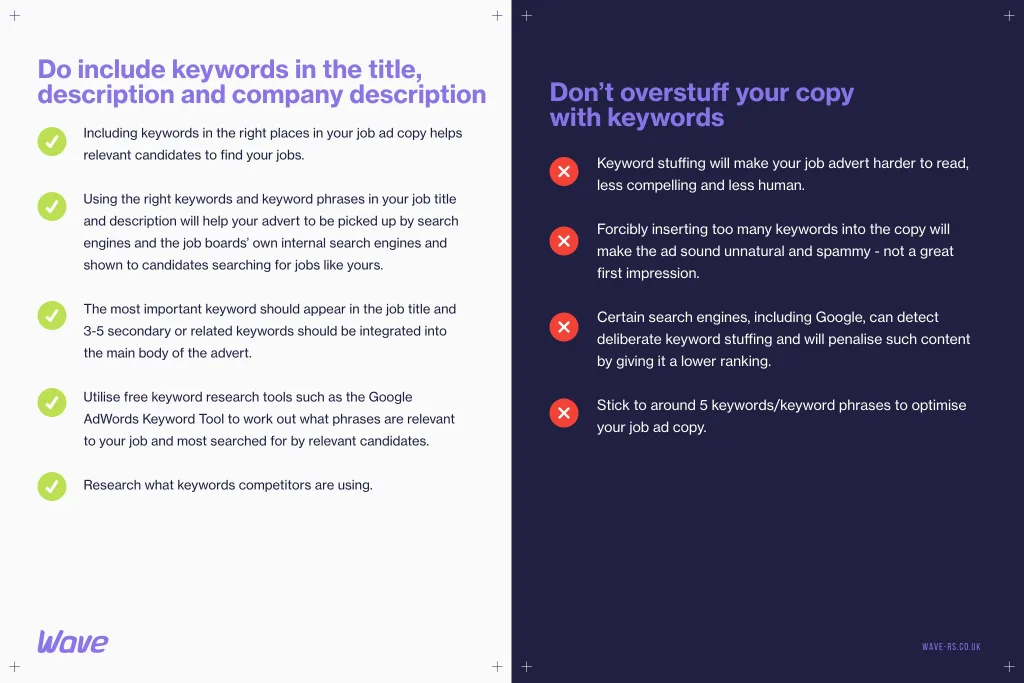
Do Include keywords in the title, description and company description
Including keywords in the right places in your job ad copy helps relevant candidates to find your jobs. In order for your ad to be picked up by search engines and the job boards’ own internal search engines and shown to candidates searching for jobs like yours, it really is essential that the right keywords and keyword phrases are used in your job title and description. Utilising free keyword research tools such as the Google Ads Keyword Planner is a great way to work out what phrases are relevant to your job and most highly searched for by relevant candidates. It’s also a good idea to research what keywords competitors are using. The most important keyword should appear in the job title and 3-5 secondary or related keywords should be integrated into the main body of the advert.
Don’t overstuff your copy with keywords
You want search engines to find your job advert when candidates search for jobs like yours but you don’t want to overuse keywords. Keyword stuffing will make the advert harder to read, less compelling and less human. Forcibly inserting too many keywords into the copy will make the ad sound unnatural and spammy – not a great first impression. Not only that, certain search engines, including Google, can detect deliberate keyword stuffing and will penalise such content by giving it a lower ranking.
Using these dos and don’ts as a guide when creating your job adverts should help you to craft adverts that relevant, high calibre candidates find, engage with and want to apply for. And always remember – as a recruiter, you’re an expert at selling jobs so use that to help you to write job adverts that convert!