
The flexible working journey only really picked up pace when the world was turned upside down by the COVID-19 pandemic. In 2019, flexible working was virtually unheard of outside of part-time work, though there was a growing movement for change. Wave held a Talent Matters event focusing on the huge benefits of flexible working in February 2020, not knowing that just a month later we would all be told to stay at home and that flexible working would be about to undergo a globally enforced trial on a macro scale.
In 2020 most of us worked from home. In 2021 there were tentative steps back to the office. In 2022 businesses tried to work out what worked best for them – remote, hybrid or back to the office 5 days a week – though not many were enforcing the latter. In 2023, we’ve seen a big shift in companies mandating a return to the office, whether for 2 or 3 days or full time. Why are they making a U-turn? A perceived lack of productivity, a concern that mentoring and proximity learning will be impacted, just because they can now that the pendulum is slowly shifting towards employers once more – all of these reasons have been given.
Yet, survey after survey tells us that this is not what employees and candidates want. And surveys on the recruiter side are suggesting that jobs advertising some form of flexible working result in more applications. In 2024 there will also be the added impetus of a law that gives employees the legal right to request flexible working from day one on the job. It seems employees and candidates are pushing harder for flexible working while businesses are simultaneously moving in the other direction, away from truly flexible working. There is clearly a huge disconnect here and it will be interesting to see how this plays out in 2024.
Here, we look at how flexible working has grown from 2018, in what area it’s declining, which industries are flexible working champions and what candidates and employees really want.
The growth of flexible working
It’s when we dig into our data that we gain a clearer picture of what’s going on in terms of the flexibility that’s being offered in jobs and there’s a clear evolution across the years from 2018 up to 2023. From the pre-pandemic years of traditional working models, we see heady growth in flexible working in 2020 up until 2023 when all but hybrid jobs decline in 2023. Have we reached a turning point in the flexible working narrative?
The rise and fall of flexible working jobs
In the graph plotting all jobs that are advertised with any flexible working terms, we can see that in the pre-pandemic years of 2018 and 2019 they accounted for just 1.1% and 1.3% respectively. Roll on to 2020, when the world of work was changed forever by the consequences of the stay at home mandate, and that figure rises to 3.1% – triple that of 2018. Flexible working jobs then keep rising, up to 6.1% in 2021, peaking at 7.5% in 2022.

However, in 2023 jobs advertised with flexible working terms drop to 5.4%, the lowest they’ve been since 2020. This shift seems to prove what has been reported at length in the news – a corporate back-pedalling on flexible working. After a plethora of businesses publicly announced their flexible working policies in the immediate aftermath of the pandemic – prompting many employees to make big life decisions such as moving further away from the office – 2023 seemed to be the year that reversals in policy were made. Some of the biggest companies in the world – Apple, Amazon, Disney, Google, Zoom, and Meta, to name but a few – began to mandate that employees returned to the office. With an increase in the unemployment rate and Wave data showing an uptick in applications in Q3 and Q4, there appear to be the beginnings of a shift in the power balance back towards employers.
2023: the year of hybrid working
What is interesting is that, when you look at our flexible working data at a more granular level, separating out some of the different types of location-based flexibility, there is one form that bucks the trend. Hybrid jobs are the only form of location-based flexible working that increased in 2023. In fact, they barely made the graph until 2022 but then continued to grow in 2023. Looking at graph x, this becomes even clearer. Working from home and remote jobs both dip in 2023, with only hybrid jobs continuing an upwards trajectory.
This is likely partly due to an uptick in the adoption of the term ‘hybrid’ but is undoubtedly also a reflection of the fact that hybrid working has become the compromise that best works for the majority of employers and employees. What hybrid means will differ from organisation to organisation – it might mean a set 2 or 3 days in the office, or the ability to come into the office on days that suit each individual employee or even just certain days of the month that all employees come together. And this continues to be defined and redefined across the world of work as we all figure out the best solution.
The industries that champion flexible working
As predicted, some industries have adopted flexible working practices more than others. Similar industries crop up over all forms of flexible working but IT & Internet and Education are posting by far the highest numbers of flexible working jobs.
Location flexibility by industry
Location flexibility is what many people think of when conversations around flexible working arise. This could be remote, hybrid, work from anywhere, or a number of other possibilities. We’ve analysed the data on jobs advertising flexible working/remote/working from home and hybrid across different industries.
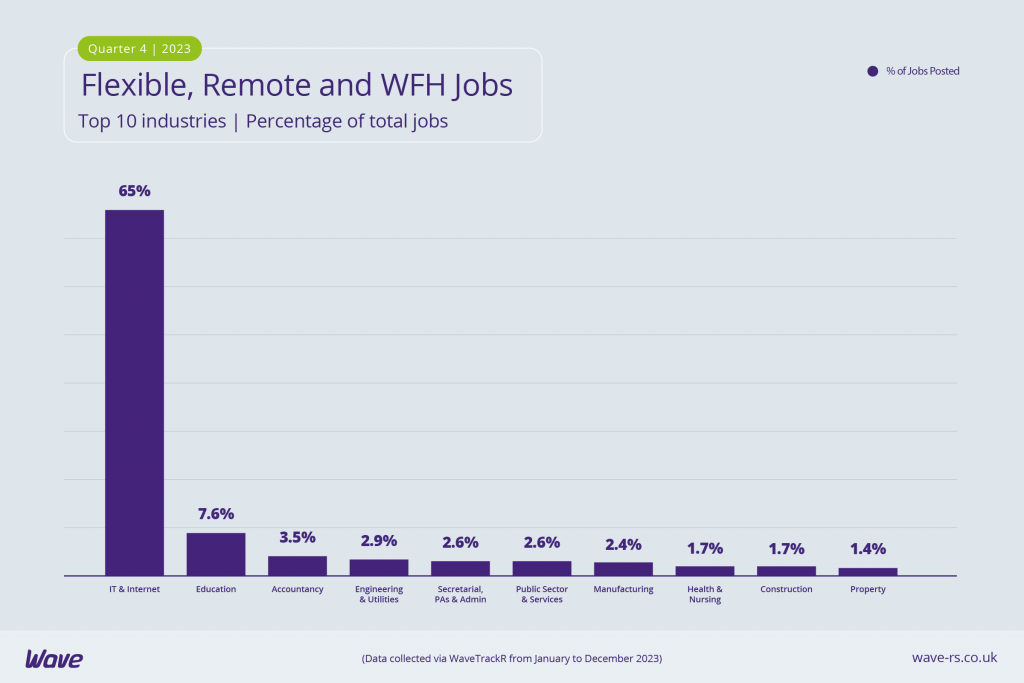
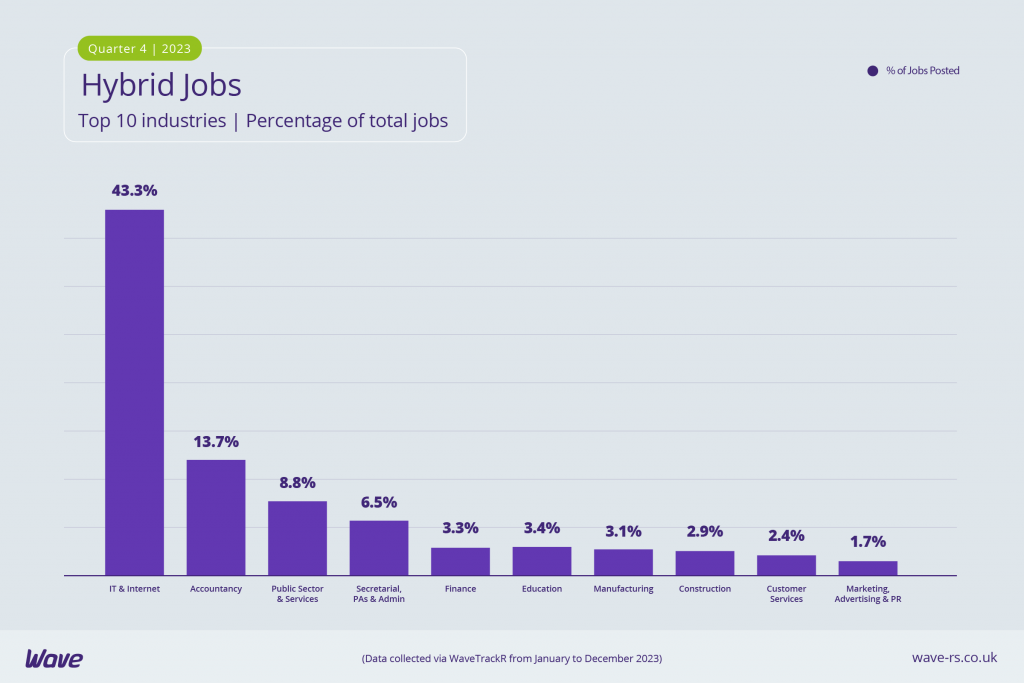
IT & Internet dominate when it comes to flexible working/remote/working from home jobs, advertising 65% of all such jobs. The industry also advertises 43% of all hybrid jobs. As a predominantly virtual sector, it’s an industry with many roles that can be worked flexibly. It’s also an industry with a high number of jobs, so those jobs need to be competitive and appealing to candidates.
Education advertised the second highest percentage of flexible/remote/working from home jobs, although at 7.6% it was significantly lower than IT & Internet. Accountancy – another industry with a high proportion of roles that can easily be worked flexibly – also advertised a larger percentage of all forms of flexible working jobs. Public Sector & Services, an industry that consistently finds itself amongst the 5 industries receiving the lowest average numbers of applications per job, also charts relatively highly for hybrid jobs. As an industry that can offer flexibility, it is likely using the lure of flexible working to try and attract candidates to its jobs.
Time flexibility by industry
When flexibility is discussed it’s often done so with location flexibility in mind, i.e. where you work. However, flexible working can span a range of different mediums, including time flexibility. Here, we’ve looked at industries advertising part-time jobs and those advertising contract jobs.
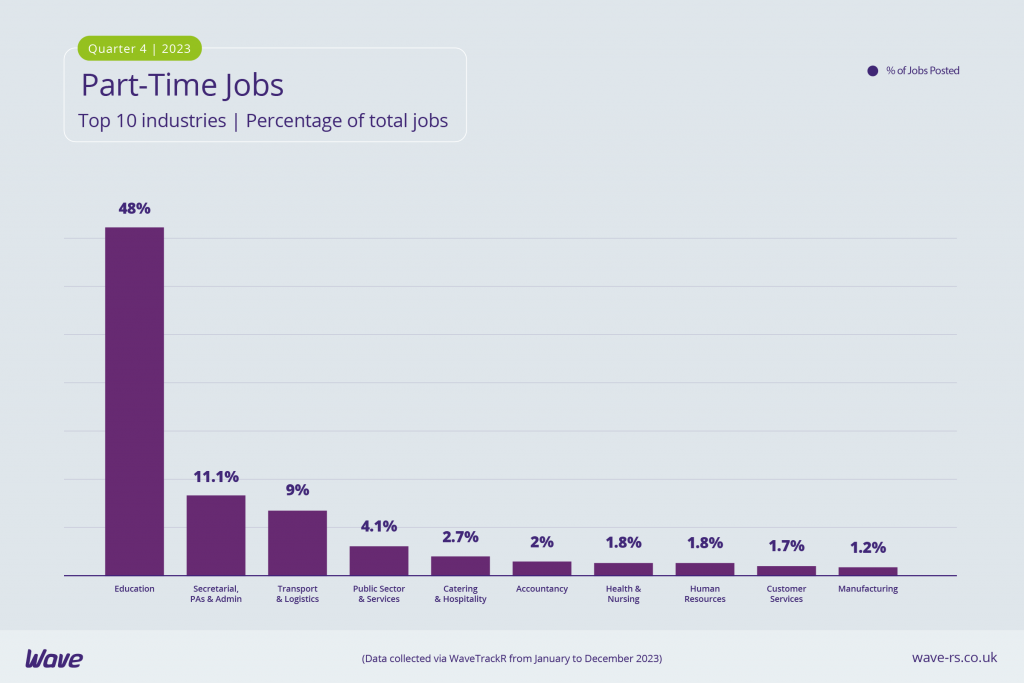
Education dominated both categories but particularly part-time jobs, accounting for 48% of all part-time jobs advertised. A growing number of teaching staff and those in administrative roles in educational settings now job share, which is helping to fill vacancies in an industry dogged with skills shortages. Education also advertised 30% of all contract jobs, likely due to demand for high number of substitute teachers and educational consultants. It’s also a cost-effective solution for an industry facing mounting budgetary pressures.
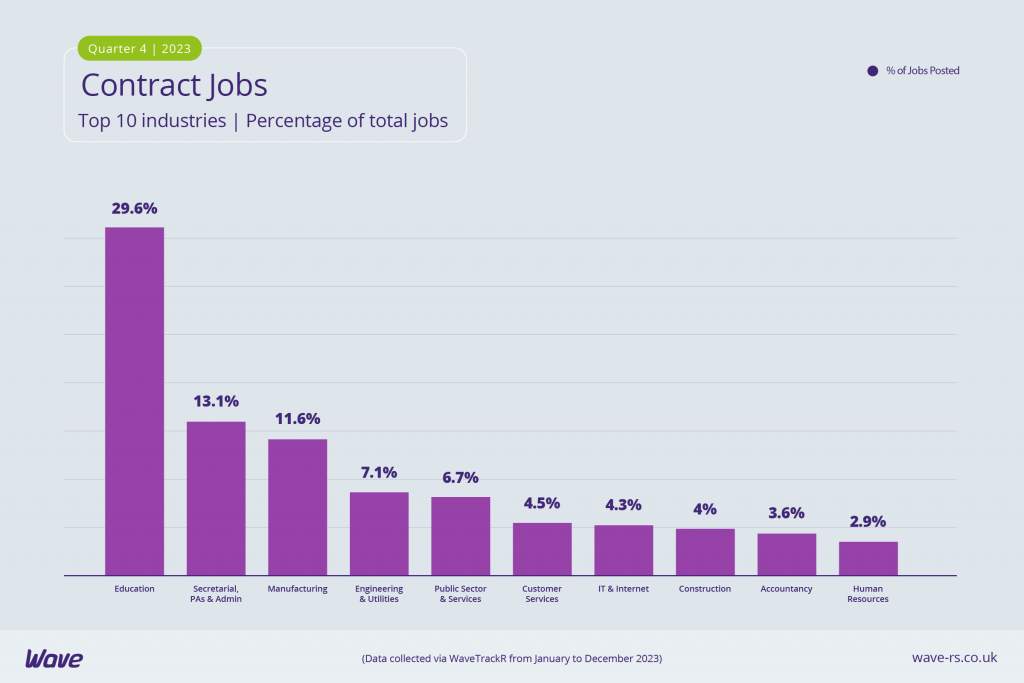
Secretarial, PAs & Admin – an industry that has historically been known for offering part-time roles – advertised the second highest percentage of both part-time and contract jobs. This makes it a great industry for working parents that need more time flexibility and older workers that want to continue working but not full-time. Also advertising a relatively high percentage of part-time jobs is Transport & Logistics, an industry popular with those taking on second jobs, which many people had to do in 2023 thanks to the increasing cost of living.
Flexible working – a huge candidate motivator
Some organisations may be doing a U-turn on flexible working but the reality is that it is a huge draw for candidates. In fact, more than that – withdrawing flexible working options and mandating a return to the office can be a huge motivator to start searching for another job. In a survey of recruiters carried out by Wave, a huge 90% of respondents said that they receive a greater number of applications for jobs with flexible working.
2023 Totaljobs research found flexible working hours to be the most sought after benefit and LinkedIn data has consistently found flexibility to be amongst the top three candidate motivators when looking for a job. A Deloitte survey found that, among respondents who still work remotely at least part-time, 66% would likely leave their current role if mandated to return to the office five days a week. Although there may be more candidates in the market now and the pace of jobs has slowed, there remains a skills mis-match, meaning that attracting the right candidates for your jobs could still be challenging in 2024. Ignoring what a huge percentage of the market wants from a job could be hugely damaging.
An evolving journey
The pandemic was the catalyst for a change to the way we work, the likes of which we hadn’t seen since the Industrial Revolution. We’re feeling our way through how flexible working works in different industries, across different roles and for different people, and that journey is ongoing. Meanwhile, we can be sure of two things: one, that we will never go back to 9 to 5 in the office, 5 days a week as the norm, and two, that flexible working will continue to evolve through 2024 and beyond.