Flexible working’s growth journey
Pre-pandemic, flexible working options barely existed outside of a relatively small number of part-time or job share roles. Location flexibility was a rare nugget of gold and similarly prized. The ability to work from home or a location other than your usual place of work was unusual before 2020. And then of course the world was tipped upside down and everything changed. The ensuing years looked something like this:
2020: Most of us worked from home, initially because it was mandated by law.
2021: There were tentative steps back to the office but many businesses allowed their employees to decide for themselves what they felt most comfortable with or what suited them. Many employers and employees were still nervous about mixing in a confined office space and wanted to wait until the vaccination programme was more established.
2022: Following two years of restrictions and many having worked from home for a long time, businesses tried to work out what worked best for them – remote, hybrid or back to the office 5 days a week. Not many were enforcing a full return to the office.
2023: We’ve seen a big shift in companies mandating a return to the office, whether for 2, 3 or 4 days or full time. Flexible working has not died but there has been a seismic shift.
The rise and fall of jobs with flexible working
Wave data shows a clear pattern from the pre-pandemic years up to 2022. The percentage of jobs advertising flexible working terms rises from just over 1% in 2018 and 2019 to 3.1% in in 2020, tripling its figures in a short space of time. When the stay at home mandate ended, working from home did not. Many had become used to the greater balance it brought to their lives, ridding them of the 5 day a week commute, freeing up time for hobbies or family, saving money on travel expenses and even moving when the need to be close to their place of work vanished. They didn’t want to return to the 9 to 5, 5 days a week in the office. The pandemic had shown it was completely possible to work from home at least part of the time, especially as it forced organisations to put the technology and policies in place that were needed to enable it.

So, in 2021, as we were beginning to climb our way out of the pandemic, jobs advertising flexible working didn’t decline as some feared. They rose to 6.1% and in 2022 they peaked at 7.5%, a significant rise from the 1% share they had in 2018 and 2019. Flexible working was on a huge growth curve, driven largely by the fact that jobs were through the roof and applications were relatively low. The ball was very firmly in the candidate’s court and employers were very aware of that. Competition for skilled candidates in the majority of industries was fierce and offering flexible working could give you an advantage in the race to hire.
Cut to 2023, however, and the trajectory reverses. Jobs advertising flexible working drop to 5.4%, the lowest they’ve been since 2022. So what happened? Employees and candidates certainly don’t want flexible working any less. It remains a huge candidate motivator, as evidenced by a number of large surveys and reports. 2023 Totaljobs research found flexible working hours to be the most sought after benefit and LinkedIn data has consistently found flexibility to be amongst the top three candidate motivators when looking for a job. A Deloitte survey found that, among respondents who still work remotely at least part-time, 66% would likely leave their current role if mandated to return to the office five days a week. So why the U-turn?
Are employers taking advantage of the market shift?
From Apple to Zoom (oh, the irony) and a whole host in between, huge companies announced an adjustments to – and sometimes a complete reversal of – flexible working policies last year. The desire for organisations to get people back to the office, whether for part of the week or full time, was a mainstay in the news in 2023. The reasons given? A perceived lack of productivity, a concern that mentoring and proximity learning will be impacted, or just because they can now that the pendulum is slowly shifting towards employers once more. There’s perhaps a lack of trust in some organisations too – an issue that many would say is more down to leadership than genuinely untrustworthy employees.
But the shift in the market is likely the catalyst for many organisations to reverse their flexible working policies now.
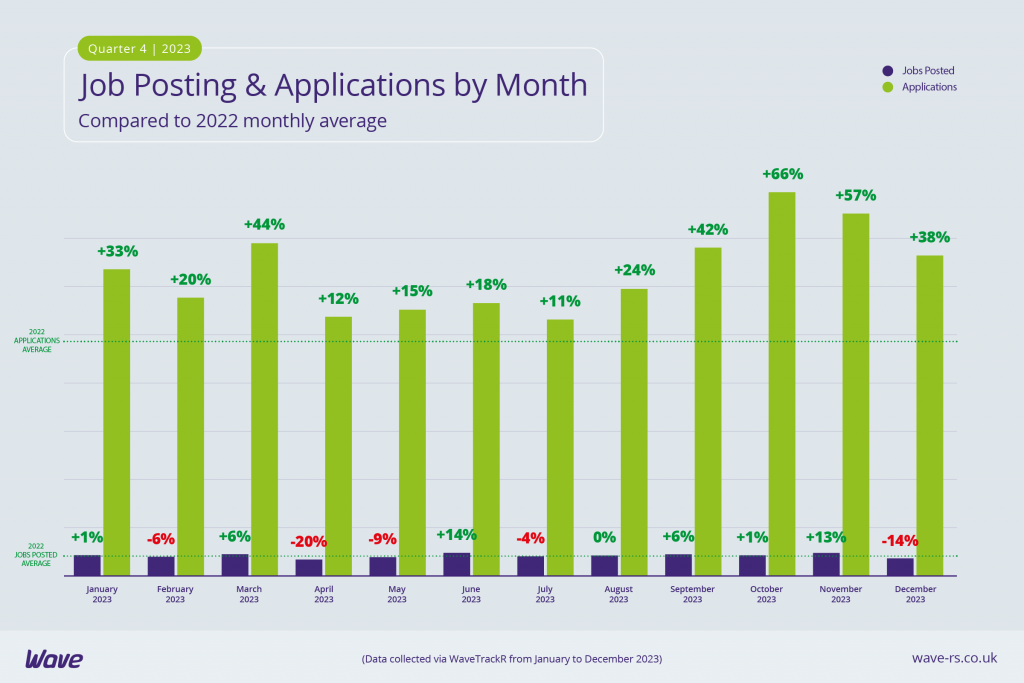
Wave’s Q4 2023 Recruitment Trends Report found that applications were up on 2022 numbers every quarter in 2023, with Q4 applications 54% over the 2022 quarterly average. Meanwhile, jobs were either under Q3 figures or equalled them. In 2023, the market was no longer fully candidate-driven, giving employers the opportunity to shift their policies. However, this disconnect between what candidates and employees want and what employers are offering could be dangerous as what we have all come to expect since the pandemic is the unexpected, that things can change very quickly. Ignoring what candidates and employees want is a risky move.
Is the future hybrid?
Of course, flexible working doesn’t have to mean all or nothing and hybrid working has emerged as a front runner in the way that we work. Wave data has shown that hybrid was slower to emerge in job ads but is the only type of flexible working that has continued to rise from 2020 onwards.
This may, in part, be down to an increase in the adoption of the term ‘hybrid’ but it is undoubtedly also a reflection of the fact that hybrid working has become the compromise that best works for the majority of employers and employees. Allowing a combination of in-person and at-home time, it gives both employers and employees a little of what they want. Employees get to socialise with colleagues without committing to a full return to the commute and employers get the in-person collaboration they want from their teams.
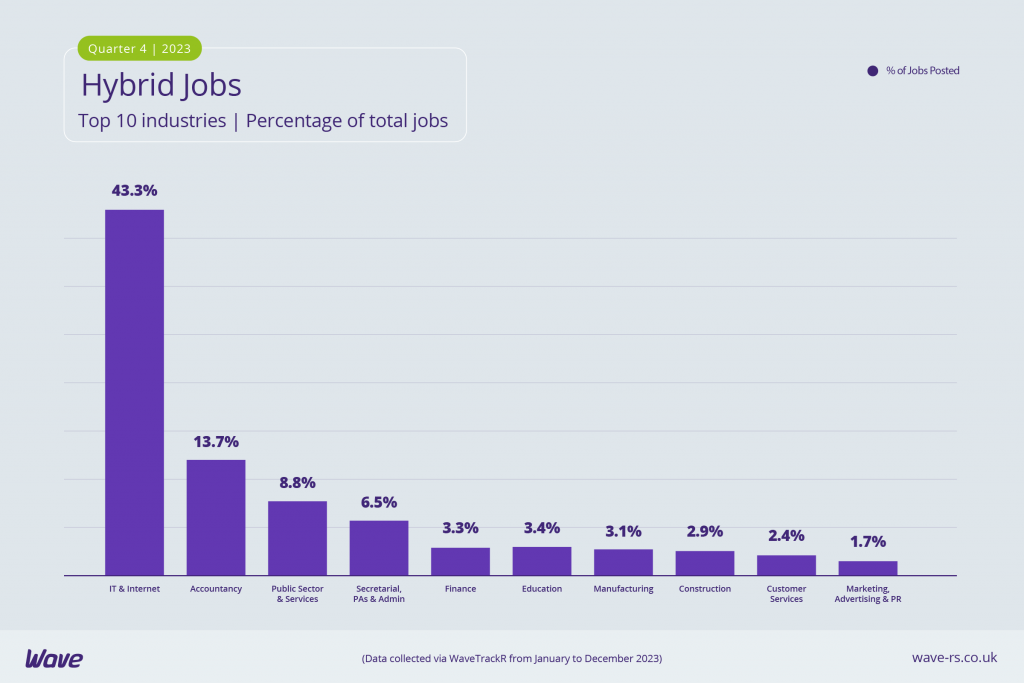
Some industries have adopted hybrid working more than others, as Wave data shows. Currently, IT & Internet dominate when it comes to hybrid working, advertising 43% of all such jobs. As a predominantly virtual sector, it’s an industry with many roles that can be worked flexibly. It’s also an industry with a high number of jobs, so those jobs need to be competitive and appealing to candidates. Public Sector & Services, an industry that consistently finds itself amongst the 5 industries receiving the lowest average numbers of applications per job, also charts relatively highly for hybrid jobs. As an industry that can offer flexibility, it is likely using the lure of flexible working to try and attract candidates to its jobs.
What hybrid means will differ from organisation to organisation – it might mean a set 2 or 3 days in the office, the ability to come into the office on days that suit each individual employee, or even just certain days of the month that all employees come together. And this continues to be defined and redefined across the world of work as we all figure out the best solution.
Flexible working: not just work from home
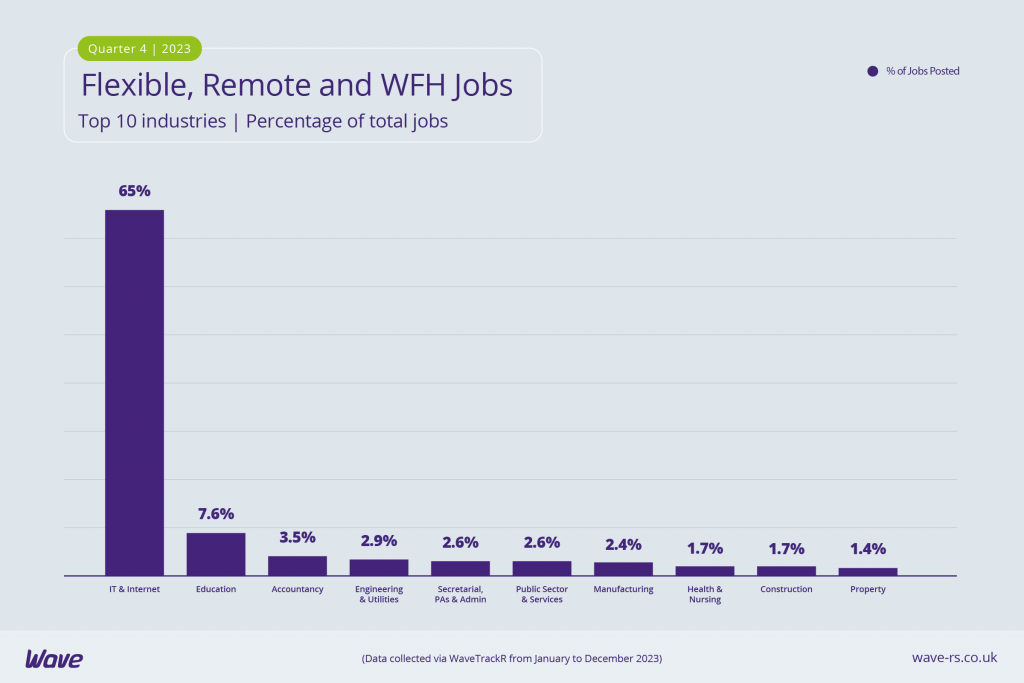
When people think of flexible working, they often think only of the ability to work from home. It’s why so many in frontline jobs rail against flexible working as a work policy that they will never be able to take advantage of and why frontline organisations say that flexible working just wouldn’t work for them. However, flexible working can take many forms. As well as location-based flexibility (fully remote or hybrid), there is a huge range of time-based flexible options, including (but certainly not limited to) part-time, term time, job share, flexitime, compressed hours, annualised hours, and a company-wide 4-day week. Many of these options could be offered even if the role is location specific.
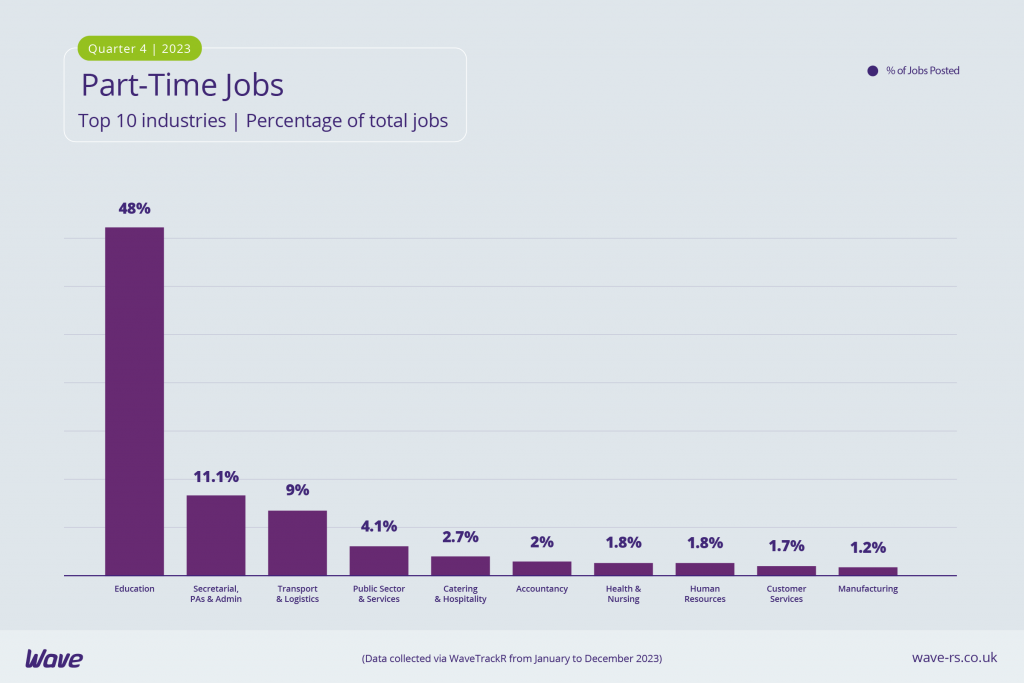
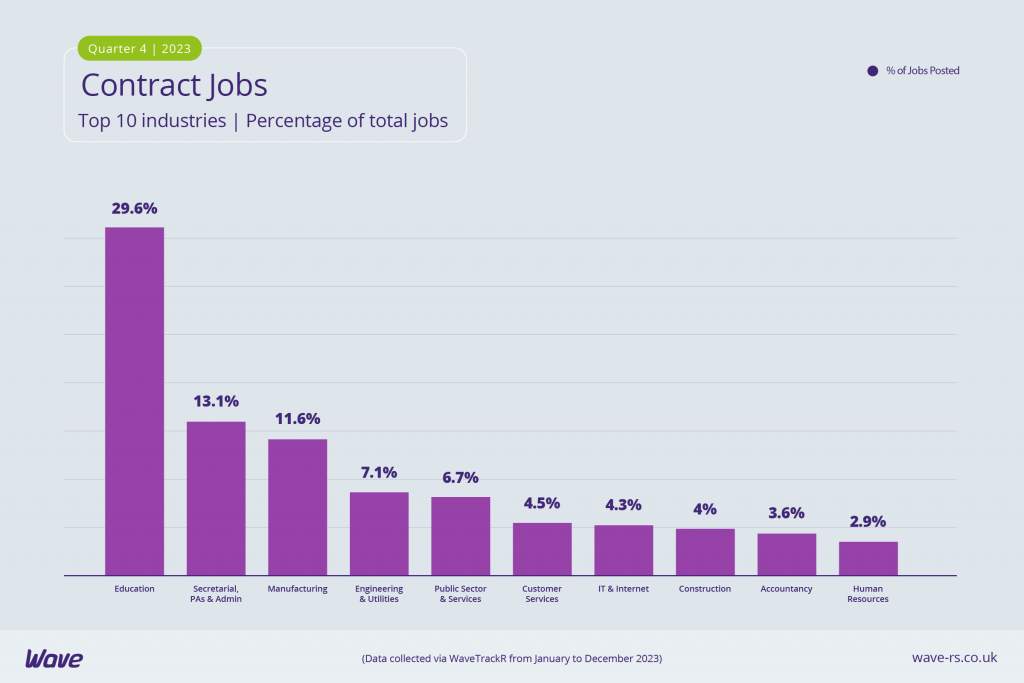
As with location flexibility, some industries have adopted time flexibility more than others. For example, Wave data has shown that Education accounted for a huge 48% of all part-time jobs advertised in 2023. A growing number of teaching staff and those in administrative roles in educational settings now job share, which is helping to fill vacancies in an industry dogged with skills shortages. Education also advertised 30% of all contract jobs, likely due to demand for high number of substitute teachers and educational consultants. It’s also a cost-effective solution for an industry facing mounting budgetary pressures.
Secretarial, PAs & Admin – an industry that has historically been known for offering part-time roles – advertised the second highest percentage of both part-time and contract jobs. This makes it a great industry for working parents that need more time flexibility and older workers that want to continue working but not full-time. Also advertising a relatively high percentage of part-time jobs is Transport & Logistics, an industry popular with those taking on second jobs, which many people had to do in 2023 thanks to the increasing cost of living.
What candidates want (and often need)
I’ve spoken about the myriad benefits of flexible working for employees, employers, recruiters and the economy as a whole in a previous Deep Dive so I won’t list them all. Suffice to say that if every role offered some sort of flexibility, be that time or location (and it is possible, in pretty much any industry, it just needs a little adjustment), we would all be in a far better place. Swathes of the population that hadn’t been able to work previously (but are highly capable given some form of flexibility in either time or location) would be able to enter the labour market. Suddenly the talent pool would be a whole lot bigger. Hard-to-fill vacancies would be filled, historic skills shortages would be reduced. The economy would be stronger. We could begin to close the gender pay gap. Now I’m certainly not saying that all this will happen overnight or that flexible working will solve all societal and economic problems but it would absolutely help to make huge changes.
In a 2023 Talent Matters podcast episode, CEO & Founder of Diversifying Group, Cynthia V Davis CBE, explained how flexible working has hugely impacted diversity and inclusion:
“Remote and hybrid working has allowed people with disabilities to do great work and be more productive. It’s opened up more talent pools as it’s brought people back into the world of work that would have otherwise considered it not effective for their lifestyle. Geographical locations need not be a barrier anymore. It’s opened up more avenues for people who for so long were excluded from the workforce.”
Cythia V Davis CBE, CEO & Founder of Diversifying Group
A rise in applications
And recruiters are finding again and again if they advertise a job with flexibility in either where the job takes place or when you do it, they will get more applications. In a survey of recruiters carried out by Wave, a huge 90% of respondents said that they receive a greater number of applications for jobs with flexible working. It continues to be a huge draw for candidates and for employees looking to leave a job that doesn’t offer flexible working – or that has had flexible working withdrawn. In 2024 there will also be the added impetus of a law that gives employees the legal right to request flexible working from day one on the job. Organisations pushing against flexible working will find that there are a lot of people pushing against them.
A continuing evolution
We’re certainly not at the end of the journey when it comes to flexible working, and as digital tech and AI continues to advance, how, where and when we work will continue to evolve. What is clear is that we will never go back to 9-5, 5 days a week in the office as the norm. And flexible working will continue to be huge asset when attracting candidates, whatever the status of the market. There may be more candidates in the market than there was a year ago but if you are looking for the very best, you will always have the competitive edge by offering flexible working. Furthermore, there remains a skills mis-match so recruitment in 2024 will likely continue to prove challenging in a number of industries. Flexible working will help you to find the candidates you need and help candidates to apply for positions that they wouldn’t have been able to without the flexibility they offer. What that will look like in years to come will undoubtedly further evolve.
Want to explore this topic more? We recommend:
✍️ Q4 2023 Recruitment Trends Report: The impact of flexible working on recruitment
✍️ The Deep Dive: Want more applications? Offer flexibility.
✍️ How flexible working went from workplace unicorn to candidate priority